.png)
.png)
BCM assessment software should help a program see recurring weaknesses without flattening unlike records into one list. That requires two connected views: the original finding or gap with its source and evidence, and a controlled thematic classification that supports analysis across business units, standards, and review cycles.
This article covers records from formal internal audits, BCM self-assessments, customer reviews, and regulatory examinations. Those records are not interchangeable. Preserve the source’s terminology, criteria, and authority rather than relabeling every assessment gap as an audit finding.
In short
- Preserve the source record, including its terminology, criterion, scope, and evidence.
- Assign one primary theme and use a secondary theme only when it improves analysis.
- Do not treat a shared theme as proof of a shared root cause.
- Record risk exposure separately from requirements and commitments.
- Keep theme analysis, triage, remediation, and residual-risk approval connected but distinct.
- Evaluate Compliance Confidence as BCM assessment software, not as a general audit-issue management platform.
Require Both Source Detail and a Thematic View
For this article, a recurring finding is the same or a materially similar condition appearing across review cycles, business units, standards, or assessment sources. Similar wording alone does not prove recurrence. The team must compare the underlying criterion, condition, scope, and evidence.
Useful software should preserve two levels of information:
- The source record: What was identified, by whom, against which criterion, in what scope, and with what evidence.
- The thematic view: Which broader program weakness the record may share with findings or gaps from other sources.
The thematic label helps the program see patterns. It must not overwrite the original language or make a self-assessment gap appear to carry the authority of an internal audit or regulatory examination.
The 2024 Global Internal Audit Standards, effective January 9, 2025, address evaluating findings, developing recommendations or action plans, communicating results, and confirming implementation. They apply to professional internal audit work. They do not establish a universal BCM taxonomy or require the six themes below.
Classify Recurring Findings Without Inventing a Root Cause
Start with a limited set of categories that can be applied consistently. The objective is to make a valid pattern visible while preserving the detail needed for a defensible response.
A practical six-theme starting point
| Theme | Conditions that may fit the theme | What an assessment system should let the team examine |
|---|---|---|
| Governance and ownership | Missing approvals, unclear accountability, overdue reviews, or decisions without an authorized owner | Records by owner, business unit, approval state, and age |
| Criteria and requirement mapping | An unclear benchmark, outdated version, conflicting criteria, or an unrecorded requirement | Criterion, source, version, applicability, and required date |
| Documentation and current-state alignment | Plans, BIAs, procedures, or contacts that no longer reflect operations | Record history, review date, scope, and related change |
| Evidence sufficiency and retrieval | Evidence that is missing, stale, incomplete, or disconnected from the result it supports | Evidence references, dates, reviewers, and related records |
| Execution and validation | Plans or controls that exist but have not been implemented, exercised, or shown to work as intended | Assessment result, test or exercise reference, action, and reassessment status |
| Follow-through and closure | Actions without owners, repeated extensions, unsupported closure, or a condition that reopens | Owner, status, target date, closure evidence, reviewer, and history |
These are classification categories, not a claim that these are the statistically most common BCM findings.
Three rules for consistent classification
- Assign one primary theme. It should represent the main condition the record reveals.
- Use a secondary theme sparingly. Add it only when it changes filtering, reporting, ownership, or response analysis.
- Do not infer root cause from the category. Several findings can share a theme while having different causes.
Review the taxonomy after each major assessment cycle. Merge inconsistent labels, clarify definitions, and preserve historical mappings when a category changes.
Regulated-sector examples show why source detail matters. The FFIEC Business Continuity Management guidance addresses governance, planning, exercises, maintenance, and board reporting for covered financial institutions. An examiner finding should remain distinguishable from an internal policy gap in the same theme.
The CMS health care provider guidance covers risk assessment and planning, policies and procedures, communications, and training and testing for applicable providers and suppliers. Related records can share a theme, but each must retain its provider-specific requirement.
Keep Theme Analysis Separate From the Response Decision
A theme explains what may be repeating. It does not authorize corrective action, accept exposure, or close a finding.
| Activity | Question it answers | Boundary to preserve |
|---|---|---|
| Theme analysis | What broader weakness may this record indicate? | Do not alter the source record or claim a common cause without evidence |
| Finding triage | Does the issue require clarification, corrective action, acceptance, or another approved response? | Decide the response before creating a remediation item |
| Remediation management | What approved work will be completed, by whom, by when, and with what closure evidence? | Put only approved corrective actions in the remediation queue |
| Residual-risk governance | What exposure remains, who can approve it, and when must it be reviewed? | Keep acceptance authority and evidence separate from unfinished corrective work |
For the detailed routing process, see BCM Assessment Findings: Build a Remediation Queue. When the approved response includes accepting remaining exposure, use a governed record such as the one described in Residual Risk Documentation for Audit.
Separate exposure from requirements and commitments
Do not use a single “risk” field to represent three different decisions.
- Risk exposure: What could happen if the condition persists, including the affected service, process, customer, finances, safety, or reputation.
- Requirement or commitment: The applicable law, regulation, contract, customer commitment, policy, or adopted standard, including any deadline.
- Sequencing priority: When the organization will act after considering both dimensions and its approved decision criteria.
A material exposure may have no externally imposed date. A lower-exposure documentation condition may still have a fixed requirement. Similar themes also do not create identical obligations across industries.
Test the Software With a Real Finding
A cross-cycle example
Assume a BCM program has three separate records:
- An internal assessment cannot confirm plan approval after a major process change.
- An exercise action was marked complete, but the evidence does not show that the affected procedure was retested.
- A customer review finds that the named plan owner left the organization and no replacement approval is recorded.
The records should remain separate because their sources, criteria, evidence, owners, and response decisions differ.
The first and third records may share the primary theme Governance and ownership. The first and second may also carry the secondary theme Evidence sufficiency and retrieval. That view supports a review of approval and verification controls, but it does not prove one root cause.
What to ask a vendor to demonstrate
The following are buyer requirements, not claims about a particular product. Bring one sanitized record to the demonstration and ask the vendor to show the workflow.
- How does the system preserve the source, criterion, version, scope, and evidence reference?
- Can users apply controlled themes without rewriting the source text?
- Can the team filter by theme, source, assessment, business unit, period, owner, and status?
- Can it record exposure separately from requirements and deadlines?
- Can an approved action remain connected to its source, owner, date, and closure evidence?
- What history remains when an assessment is repeated or a condition reopens?
- Can reports trace theme totals to the records behind them, and which functions require configuration or another system?
A dashboard alone does not make reporting defensible. Reviewers must be able to trace each total to the records, criteria, evidence, and decisions behind it.
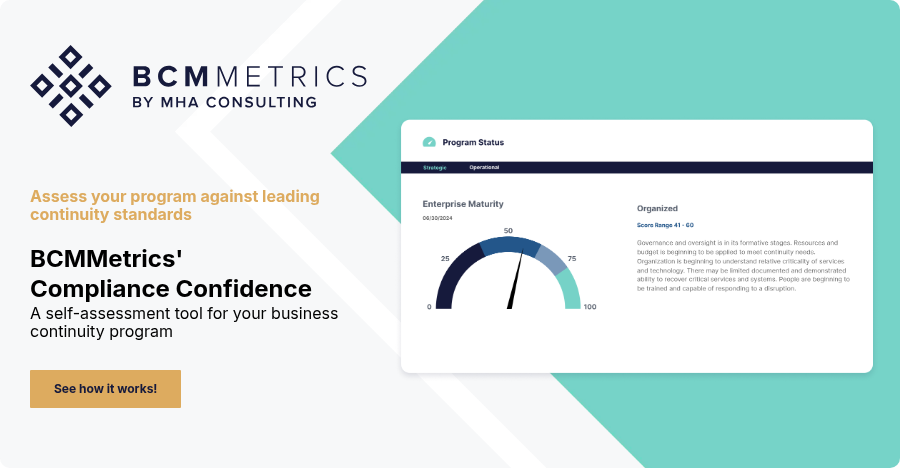
Use Compliance Confidence for Structured Assessment Follow-Through
Compliance Confidence is BCM self-assessment software. Its current public product page describes:
- guided assessments based on selected standards;
- action-item assignment and built-in messages;
- action progress displayed by sub-dimension;
- assessment history and the ability to copy prior assessment data into a new assessment;
- reports for managers or auditors; and
- exports to Excel, Word, PDF, or print.
Approved BCMMetrics materials also describe maintaining supporting documents with assessment dimensions. Confirm that document workflow during product evaluation because it is not explained on the current public page.
These capabilities support structured assessment and follow-through. They do not make Compliance Confidence a general audit-issue management platform or replace decisions about significance, cause, response, evidence, or acceptance.
The public product page does not describe automated theme classification, external finding ingestion, formal risk-acceptance approvals, or independent closure verification. Ask the BCMMetrics team to distinguish current capabilities, configurable elements, and governance that remains outside the module.
For consulting-led guidance on scoping a program review and turning gaps into an improvement roadmap, read MHA Consulting’s Business Continuity Compliance Gap Analysis.
Turn Repetition Into a Program Decision
Recurring findings should lead to a better management question, not merely a larger list. Preserve each source record, classify the shared pattern, and determine whether the program faces an isolated task or a broader weakness. The software should make that pattern easier to examine without making the records harder to defend.
Start with the Compliance Confidence Assessment to evaluate your current readiness. If you are comparing software, request a BCMMetrics demonstration and bring one sanitized assessment record to test the module’s current assessment, action, history, document, and reporting capabilities.