.png)
.png)
BIA Interviews: How to Get Consistent Inputs from Busy Stakeholders
A good BIA interview should give you usable input, not another round of cleanup.
That sounds basic, but it is where many teams lose time. Stakeholders arrive half-prepared, similar business units answer the same question in different ways, and the interviewer spends most of the call trying to normalize terms instead of validating impact, dependencies, and recovery needs. By the time the session ends, you have data, but not data you fully trust.
That is a workflow problem more than a stakeholder problem.
In short
BIA interviews work better when teams collect baseline facts before the meeting, use consistent definitions, and spend live time validating impact, dependencies, and recovery assumptions instead of gathering everything from scratch.
- Structured pre-work reduces wasted interview time
- Shared terminology improves consistency across business units
- Cleaner inputs lead to less rework, better reporting, and more credible recovery decisions
What a BIA interview is supposed to produce
A BIA interview is not just a conversation about what a department does. It is supposed to help you understand what happens if a process is interrupted, what resources and dependencies matter, how quickly disruption becomes serious, and what order recovery work should follow.
That gives you a practical test for every interview: did this session improve your understanding of impact, criticality, dependencies, and recovery priorities, or did it just produce notes?
If the answer is “notes,” the interview workflow probably needs work.
If your team is also refining how impact gets scored after the interview, see BIA Criticality Definitions and Time Bands.
Why BIA interviews go off track
Most weak BIA interviews fail for predictable reasons.
The first is that the wrong person is in the room. If the attendee is too senior, too removed from the workflow, or simply filling in for someone else, the answers may sound polished but still miss the operational reality.
The second is that teams ask live interview questions that should have been handled as pre-work. Basic process descriptions, system lists, staffing numbers, locations, and document references do not need to consume the most valuable part of the session. When they do, the interview turns into data collection instead of validation.
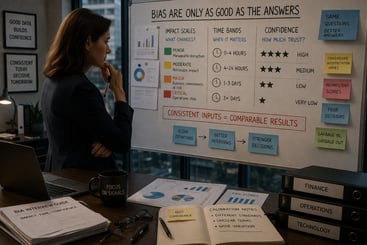
The third is inconsistent framing. One stakeholder interprets “critical” as “important to my team.” Another interprets it as “material to revenue.” A third answers based on best-case assumptions. None of them are necessarily wrong, but the dataset becomes hard to compare.
The fourth is weak follow-through. Even when interviews go reasonably well, teams often end up with scattered notes, unclear ownership, missing evidence, and too much manual normalization afterward.
This is the part practitioners usually feel most acutely. The interview itself may only take an hour. The cleanup can take far longer.
If that pattern sounds familiar, a related read is Save Time on Your BIA.
A better workflow for getting consistent inputs
A better workflow starts before the meeting.
The easiest improvement is to separate pre-work from live validation. Stakeholders are usually better at gathering baseline facts asynchronously than they are at producing them accurately in a pressured call.
A cleaner BIA interview workflow usually looks like this:
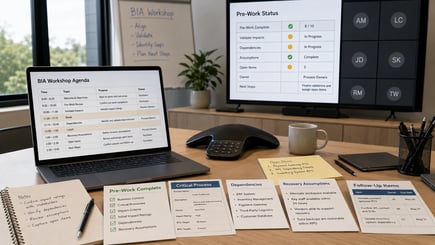
- Send structured pre-work first. Collect the facts that should not require discussion: process description, owner, key systems, upstream and downstream dependencies, peak periods, staffing assumptions, major vendors, and any known manual workarounds.
- Standardize the language before the call. Define what you mean by process, dependency, outage, impact, workaround, criticality, and recovery target.
- Use the live session to validate, not to transcribe. The interview should focus on clarifying impact, checking assumptions, resolving inconsistencies, and pressure-testing recovery logic.
- Capture exceptions clearly. If one business area needs a different impact category, timing assumption, or recovery expectation, record why.
- Close the loop quickly. Send the summary back while the discussion is still fresh, and ask the stakeholder to confirm or correct it.
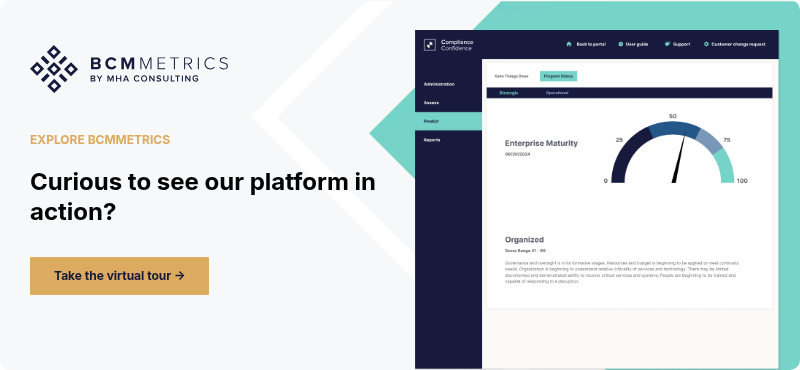
This is exactly where a platform can help without turning the article into a pitch. BCMMetrics BIA On-Demand is built around the practical problem that interview time gets wasted on fact gathering. Its pre-work questionnaire is designed to gather information before the interview so the live session can focus on validating data and establishing recovery targets. That makes it easier to reduce manual back-and-forth and keep inputs more comparable over time.
If your team also needs the deeper advisory angle on recovery target alignment, see MHA’s article on RTO and RPO in Practice: How to Set Recovery Targets You Can Defend.
The questions that usually produce better answers
The best BIA interview questions are not the most numerous. They are the ones that help the stakeholder describe impact in operational terms.
A few questions tend to produce better answers than generic “tell me about your process” prompts:
- What stops if this process is unavailable?
- Who notices first: your team, customers, leadership, regulators, or another department?
- How long can this process operate with a workaround before the impact becomes serious?
- What systems, vendors, data feeds, or people does this process depend on?
- What happens upstream and downstream if this process fails?
- What time periods make disruption worse?
- What minimum resources are needed to resume at an acceptable level?
Questions like these move the conversation from description to consequence.
You are not just collecting operational trivia. You are helping the organization build a more defensible picture of what matters most.
If the interview is feeding recovery targets, that same workflow should support cleaner prioritization and easier reporting later on.
What good BIA interview execution looks like
Good BIA interview execution is usually not dramatic. It is consistent.
What good looks like is:
- stakeholders receive structured pre-work before the session
- the interviewer uses shared definitions
- similar business units answer against the same framework
- the live session focuses on validation, exceptions, and impact logic
- follow-up is quick and specific
- the resulting data can be compared, reported, and updated without starting over
That last point matters a lot for small teams. BC practitioners often work with limited time, manual files, and uneven stakeholder engagement. BCMMetrics was built for that kind of environment, where the real win is not a flashy workflow but a more workable one: less manual cleanup, better structure, and clearer reporting over time.
Conclusion
BIA interviews go better when the interview is not trying to do everything.
If baseline facts come in before the meeting, definitions are standardized, and the live session is used to validate impact and recovery logic, the data gets better and the cleanup gets smaller. That is what most teams actually want.
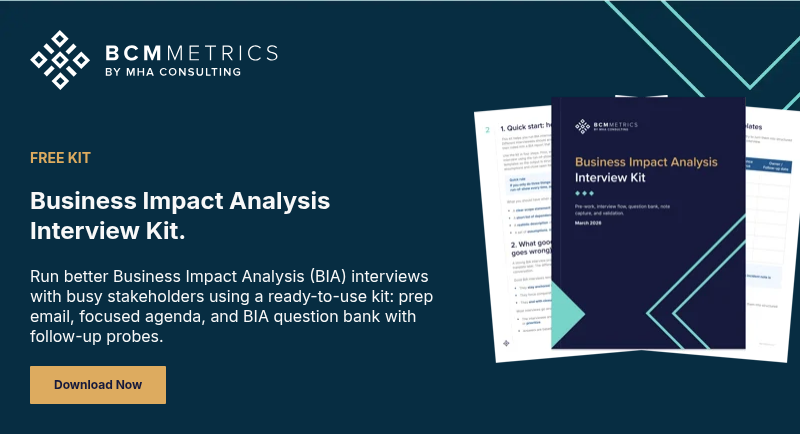
Business Impact Analysis Interview Kit
If your BIA interviews still depend too heavily on stakeholder memory, scattered notes, or manual follow-up, the Business Impact Analysis Interview Kit can help you tighten the workflow. It gives you a cleaner starting point for pre-work, interview structure, and follow-through. And if you want a more consistent way to run BIAs at scale, BCMMetrics can help your team capture better inputs with less manual effort, while keeping the data easier to review and report on.