.png)
.png)
Incident vs. crisis management comes down to scope, impact, and decision-making.
Incident management is usually about handling the event at the operational, site, system, or team level. Crisis management is about coordinating broader business impact, leadership decisions, escalation, and cross-functional response.
The practical issue is not just naming the event.
It is knowing when the response needs to move from local handling to broader coordination, and what information should move with it.
Different organizations draw the line differently. A regional healthcare provider, a manufacturer, a financial institution, and a SaaS company may use different escalation thresholds. The point is not to copy someone else’s definition. The point is to define the line before the event, not debate it during the response.
A facility issue may start as a local maintenance problem, then affect employee access, customer delivery, safety, and executive reporting. A system outage may start with IT, then move into business operations, customer communication, legal review, and recovery decisions. A supplier disruption may look manageable at first, then create downstream impacts the business was not ready for.
For program owners, the goal is not to label every event perfectly.
The goal is to know when an incident is becoming too large, too visible, or too risky to manage only through the normal operational channel.
In short
Incident management handles the event at the operational level. Crisis management coordinates the broader business response when impact, visibility, risk, or decision-making needs expand.
- Escalate when the event creates broader business impact, risk exposure, or leadership decisions
- Document what changed, who approved escalation, and what decisions are needed next
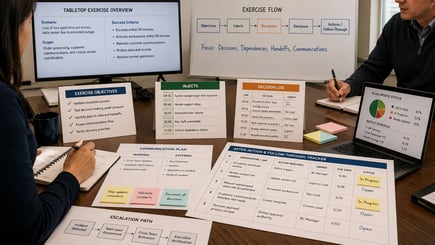
- Use site records, approved plans, contacts, incident logs, briefing agendas, and action plans to support the handoff
Incident Management vs. Crisis Management: The Short Version
Incident management handles the event.
Crisis management handles the broader organizational response when the event creates business impact, risk exposure, leadership decisions, or cross-functional coordination needs.
An incident may stay within one team, one site, one vendor relationship, or one technical process. A crisis usually crosses boundaries.
| Response area | Incident management | Crisis management |
|---|---|---|
| Main focus | Contain, resolve, and track the event | Coordinate broader business impact and decisions |
| Typical ownership | Site leader, operations team, IT team, safety team, or functional owner | Crisis management team, senior leadership, cross-functional response group |
| Scope | Local, technical, operational, or contained | Broader impact across functions, sites, customers, reputation, compliance, or safety |
| Decision level | Operational decisions within existing authority | Leadership decisions, tradeoffs, escalation, public or customer impact, resource prioritization |
| Documentation need | Incident log, actions taken, status updates, affected area | Decision records, briefing agendas, incident action plans, stakeholder updates, recovery priorities |
| Common mistake | Treating every issue like a crisis | Keeping a growing crisis trapped inside an incident process |
The difference is not always the size of the initial event.
It is whether the response now requires broader coordination and higher-level decisions.
Why the Escalation Handoff Matters
A weak escalation process creates two problems.
The first is over-escalation. Every incident becomes a crisis. Leaders are pulled into issues that the operational team can manage. The crisis team becomes fatigued, and real crises may not get the attention they need.
The second is under-escalation. An incident keeps growing, but the response stays too narrow. The right leaders are not involved. Communications lag. Legal or regulatory exposure is missed. Customer impact is not reported early enough. A site-level disruption becomes a business issue before anyone formally changes the response model.
Both problems usually come from the same source: unclear escalation criteria.
Program owners should help teams define what changes the response level. Not every organization will use the same thresholds, but the categories are often similar.
Escalation may be needed when the incident affects:
- Customer commitments
- Employee or public safety
- Regulatory, legal, or contractual obligations
- Reputation or external visibility
- Multiple sites, departments, or regions
- Executive decisions or funding
- Prolonged outage duration
- Critical suppliers, systems, or facilities
- Recovery priorities across competing business needs
A good response process does not wait for every fact to be confirmed before escalating.
It gives teams enough structure to say:
This is no longer just an operational issue. We need broader coordination.
Escalation Signals That Move an Incident Toward Crisis
Escalation signals should be specific enough for teams to use during an event.
A general statement like “escalate when the incident is serious” is not enough.
A better approach is to define observable signals.
| Incident signal | When it may stay an incident | When it may become a crisis | What to document |
|---|---|---|---|
| Local facility disruption | One site issue, limited duration, no customer or safety impact | Facility access, safety, operations, or customer delivery is affected | Site, impact, affected teams, actions taken, access decisions |
| IT or system outage | Single system issue with known workaround and contained business impact | Critical process, customer access, data, legal, or recovery priority decisions are involved | Systems affected, business processes impacted, workaround status, recovery assumptions |
| Supplier disruption | Alternate source exists and impact is limited | Critical supplier delay affects service, production, compliance, or customer commitments | Supplier, affected process, expected duration, alternate options |
| Safety or security event | Contained locally with existing procedures | Employee safety, public safety, law enforcement, media, or executive decisions are involved | Location, safety actions, notifications, decisions, next updates |
| Customer-impacting issue | Limited customer group and clear resolution path | Large customer impact, contractual issue, reputational exposure, or executive communication required | Customer impact, message status, owner, next update |
| Prolonged outage | Expected to resolve within normal tolerance | Outage exceeds tolerance or affects recovery targets | Start time, duration, escalation time, decisions, recovery plan |
This table is not meant to replace judgment.
It gives teams a shared starting point.
The value is consistency. If the same type of event is escalated differently each time, the organization will struggle to learn from its response history.

What Should Move With the Escalation Handoff
The handoff from incident to crisis response should not happen only through a phone call or chat message.
Teams need a record of what changed and why the response was escalated.
At minimum, document:
- What happened
- When it started
- Who detected or reported it
- Which site, system, process, supplier, or customer group is affected
- What actions have already been taken
- What is still unknown
- Which escalation trigger was met
- Who approved escalation
- Which team or leader owns the next response cycle
- What decisions are needed
- When the next update will happen
This does not have to be complicated. In fact, the record should be simple enough to use under pressure.
But without a basic log, the response can become hard to reconstruct later. That affects after-action reviews, leadership reporting, insurance questions, compliance reviews, customer conversations, and program improvement.
It also helps the crisis team avoid starting from zero.
A clear escalation record tells the next group what they are inheriting.
If the crisis team has to reconstruct the first hour from memory, the escalation record is too thin.
BCMMetrics fits this topic on the execution side.
The deeper advisory work of designing a crisis response structure, defining executive roles, or improving crisis leadership belongs more naturally in a consulting-led conversation. That is where MHA Consulting’s crisis response team guidance is a better fit.
But once the response process needs to be documented and maintained across sites, contacts, approved plans, incident records, and briefing materials, the work becomes operational.
BCM One supports that operational layer.
It helps teams maintain location-based records, site contacts, approved plan access, incident logs, briefing agendas, and incident action plans. That matters because many response handoffs fail when the basic information is scattered.

During an incident, a team may need to know:
- Which site is affected
- Who the site contacts are
- Which approved plans apply
- What actions have been taken
- What decisions were made
- What needs to be briefed next
- Whether an incident action plan has been created or updated
When that information is organized around the affected location or incident, the response team has a clearer starting point for coordination.
BCM One does not decide whether an event is a crisis.
It gives teams a cleaner way to record the event, maintain the site-level context, and support the handoff when escalation is needed.
When to Bring In Deeper Crisis Response Support
Some organizations need more than better incident records. They need help defining the response model itself.
That may include crisis team structure, escalation thresholds, executive decision rights, communication ownership, emergency planning, crisis exercises, or response playbooks.
That is the advisory lane.
For deeper crisis response structure, the related MHA article on crafting a crisis response team is the better next step.
For BCMMetrics, the focus is narrower and practical: help teams keep the response information organized, visible, and usable as incidents unfold.
The two pieces work together.
MHA helps clarify how the response should be structured.
BCMMetrics helps teams maintain the operational records, site details, plans, logs, and briefing materials that support the response.
Related reading
If you are reviewing escalation and response handoffs, these related resources may help:
Conclusion
Incident management and crisis management are related, but they are not the same thing.
Incident management handles the event at the operational level.
Crisis management coordinates the broader business response when impact, visibility, risk, or decision-making needs expand.
For program owners, the important question is not just, “What happened?”
It is:
When does this event need to escalate, who needs to be involved, and what do we need to document so the next group can act?
If the answer is unclear, the response process needs work.
Download the Crisis Management Handbook
If your team is reviewing how incidents escalate into crisis response, download Crisis Management: A Handbook For BCM Professionals.
It can help you think through crisis team structure, response planning, and the practical elements that support a stronger crisis management program.
And if your team needs a better way to maintain site records, approved plans, contacts, incident logs, briefing agendas, and incident action plans during response, BCM One is worth a closer look.
Take a virtual tour to see how BCMMetrics supports site-level records, incident logs, approved plan access, briefing agendas, and incident action plans.
FAQ
What is the difference between incident management and crisis management?
Incident management handles an operational, site-level, technical, or contained event. Crisis management coordinates the broader business response when the event creates wider impact, cross-functional decisions, executive involvement, customer impact, reputational risk, or regulatory exposure.
When does an incident become a crisis?
An incident may become a crisis when it affects safety, customers, legal or regulatory obligations, reputation, multiple sites, critical systems, critical suppliers, executive decisions, or prolonged outage thresholds.
What are common escalation triggers for crisis management?
Common escalation triggers include customer impact, safety impact, regulatory or legal exposure, reputational risk, multi-site impact, prolonged outages, critical supplier or system dependencies, and the need for executive decisions.
What should teams document during response escalation?
Teams should document what happened, when it started, what is affected, what actions have been taken, what is still unknown, which escalation trigger was met, who approved escalation, who owns the next step, and when the next update will happen.