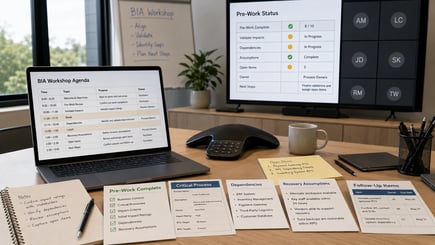
.png)
.png)
If your BIA interviews feel unpredictable, it’s usually not because people are uncooperative. It’s because the interview process leaves too much room for interpretation.
Busy stakeholders answer the question they think you’re asking. They mix current state with “best case.” They skip dependencies they assume you already know. Then you end up with scores you can’t defend, and a report that creates more debate than clarity.
I’m going to show you a practical interview approach that produces inputs you can actually use, without turning every session into a negotiation.
Related
• Business Impact Analysis Example: A Sample Assessment Using BCMMetrics
• How to Weight Your BIA Impact Categories
• What Goes Into A Business Impact Analysis (BIA) Report?
Who this is for (and when it matters most)
This is for the person running the BIA day-to-day (often a BCM analyst, coordinator, or program lead) who needs consistent, comparable inputs across departments.
It applies whether you run BIAs annually as a formal cycle, or continuously as services, systems, vendors, and org structures change. You don’t need a different interview method for each approach. You need a method that standardizes definitions, reduces opinion-driven scoring, and creates a clear trail of assumptions and sources.
The real problem: inconsistent inputs, not “bad stakeholders”
Most BIA interviews break down in predictable ways:
-
-
People answer in narratives, not in data. You get stories, but not decision-grade inputs (time to impact, workaround limits, dependencies).
-
Different departments use different definitions. “Critical” means “annoying” to one group and “existential” to another.
-
The meeting becomes a debate. Stakeholders argue over severity or negotiate scores to protect budgets and reputations.
-
You capture the wrong unit of analysis. You interview “the department,” but your BIA needs “the service” or “the process.”
- No one owns the follow-up. Inputs are incomplete, you send open items, and the thread dies.
-
The fix is not longer meetings. The fix is tighter interview design.
Before you schedule interviews: set up the conditions for clean data
1) Be clear about what you’re interviewing
Before you schedule the meeting, decide what the interview is about. Most BIAs go sideways because the stakeholder thinks they’re speaking for an entire department, while you’re trying to capture one specific slice of work.
Keep it simple:
-
-
Pick one thing to interview. A single workflow or service is usually the easiest (for example: “Order intake,” “Customer support ticket handling,” “Payroll processing”).
-
Name it the same way everywhere. Use the same label in the calendar invite, your notes, and the BIA record.
-
Avoid “tell me about your whole department.” That’s how you get broad answers that don’t translate into time targets, dependencies, or clear recovery priorities.
-
One sentence you can use in the invite:
-
-
“This interview is focused on [workflow/service], not the full [department].”
-
2) Send a pre-read that forces concrete thinking
A short pre-read reduces on-the-spot guessing. It also signals that the interview is not a brainstorming session.
Include: purpose in one sentence, definitions (criticality, downtime, workaround), scope (what service/process you’re covering), and what the stakeholder should bring (metrics, volumes, peak periods, known dependencies). Keep it short.
Example pre-read email (copy/paste)
Subject: BIA interview prep (20 minutes, focused)
Hi [Name],
We’re updating our Business Impact Analysis for [service/process]. The goal is to document time-to-impact, key dependencies, and realistic workarounds so our recovery plans match how work actually gets done.
For the meeting, please come prepared with:
- Peak periods (dates/times) and any service level commitments
- Known dependencies (systems, vendors, teams)
- How long you can operate with reduced capability or manual workarounds
- Any recent incidents that changed how you think about downtime
We’ll focus on what breaks first, when impacts become material, and what inputs we should document.
Thanks,
[Your name]
3) Pick the right interviewee mix (2–3 quick examples)
You need people who know the work, not just people who can represent the org chart.
-
-
Operations leader + frontline supervisor: captures reality vs policy.
-
Application owner + process owner: captures system constraints and business priorities.
-
Customer support manager + finance partner: captures customer-facing and financial impacts.
-
If you only interview leadership, you often get confident answers with weak detail.
4) Set a hard scope and time box
A good BIA interview is often 30 minutes with strict control. You can always add follow-ups for missing inputs. What you cannot fix later is an interview that drifted into opinion.

The interview structure that produces consistent inputs
Use a five-part structure. It works across departments because it follows a predictable path: context, time-to-impact, dependencies, workarounds, validation.
Part 1: Confirm scope in 60 seconds
Start with: “We’re assessing [service/process]. We’re focusing on impacts over time, dependencies, and realistic workarounds. I’ll send a short summary for confirmation.”
Part 2: Establish time-to-impact using time bands
You’re not asking “How bad is downtime?” You’re asking “When do impacts become meaningful?”
Use time bands that match your program, for example:
-
-
< 8 hours
-
< 24 hours
-
< 48 hours
-
< 5 days
-
> 5 days
-
Ask: “What is the first meaningful impact if this stops entirely?” and “At what point does it become unacceptable?”
Follow-ups that force specificity:
-
-
What would customers notice, and when?
-
What internal commitments would we miss, and when?
-
What backlog accumulates, and how quickly does it become unmanageable?
-
Part 3: Capture dependencies as must-have vs nice-to-have
Don’t build a dependency list that becomes a shopping cart. Split dependencies into what’s required to operate at all, what’s required to operate at a minimum acceptable level, and what can be degraded for a day or two.
-
-
Prompt for categories:
-
Systems/applications
-
Data inputs
-
Vendors
-
Locations
-
Key roles/approvals
-
Upstream/downstream teams
-
Part 4: Workarounds, grounded in constraints
Most stakeholders default to “We can do it manually.” Your job is to test whether that’s real:
-
-
How many transactions can you handle manually per day?
-
What breaks when volume doubles?
-
How long can you sustain manual processing before error rates or fatigue become a problem?
-
Who must approve exceptions when controls are bypassed?
-
Part 5: Validation and evidence
End by confirming key assumptions, unknowns, and who will provide missing data. Close with top decisions captured, open items and owners, and a commitment to send a written summary for confirmation.
A question set that reduces opinion and increases consistency
You don’t need 50 questions. You need a small set that is hard to dodge.
Core questions (use in every interview)
- What is the service/process scope for this interview?
- What is the first meaningful impact if it stops completely?
- At what time point does it become unacceptable?
- What customer, contractual, or regulatory commitments are affected, and when?
- What volumes or peak periods matter (and when do they happen)?
- What systems, vendors, and teams must be available to operate at a minimum acceptable level?
- What is the minimum acceptable level (percent capacity or specific outputs)?
- What workarounds exist, and what constraints limit them (capacity, approvals, error rate)?
- What data must be accurate or available for you to proceed (not just accessible)?
- What upstream/downstream dependencies change your answer?
- What has changed since the last BIA (systems, vendors, locations, policies)?
- What evidence can we reference (tickets, metrics, SLA docs, incident notes)?
Add 2–3 targeted questions by scenario
Pick a disruption type relevant to the service and ask one stress question:
-
-
System outage: If the primary app is down but email/Teams works, what can you still do?
-
Facility issue: If the primary site is unavailable, what shifts remote, and what cannot?
-
Vendor disruption: If a key vendor/API is down, what is the fallback and how long does it last?
-
How to handle the most common interview problems
Problem 1: “It depends”
Use: “Let’s pick the most common scenario first.” Capture the dependency as an assumption (for example, peak period vs normal operations changes the answer at 8 hours).
Problem 2: Stakeholders push for the highest criticality
Bring it back to time-to-impact: “I’m not asking how important the team is. I’m asking when impacts become material.” Separate operational inconvenience from material impact.
Problem 3: Data is missing
Don’t guess in the meeting. Capture what’s missing, why it matters, who owns it, and when you’ll receive it. Use a short follow-up request focused on only the missing facts.
Turning interviews into a clean BIA dataset
After the interview, do three things immediately:
1) Normalize language
Convert narratives into structured inputs: time band impacts, dependencies by category, workaround constraints, and explicit assumptions.
2) Run a quick quality check
-
-
Clear time-to-impact statement exists.
-
Dependencies are categorized, not just listed.
-
Workarounds are bounded by constraints.
-
Assumptions are explicit.
-
Open items have owners and dates.
-
3) Send a confirmation summary
Send a short recap and ask for confirmation. This supports internal alignment and makes later reviews easier.
Suggested summary structure: scope, time-to-impact summary, key dependencies, workaround limits, open items and owners, confirmation request.
Where BCMMetrics fits
A strong interview process gets you cleaner inputs. The next challenge is keeping those inputs consistent over time, especially when BIAs are updated continuously and stakeholders change.
If you’re managing BIAs in documents and spreadsheets, it’s common to see definitions drift between departments, dependency lists copied forward without re-validation, and BIAs going stale without anyone noticing.
BCMMetrics BIA On-Demand is designed to keep BIA data structured and reviewable, so interviews feed a dataset you can update, report on, and defend.
Practical next step
If you want a simple way to keep your BIA interviews consistent across departments, use this resource: A Step-By-Step Business Impact Analysis Checklist
Use it to standardize your pre-read, interview flow, how you capture time-to-impact and dependencies, and how you validate assumptions after the meeting.
FAQ
How long should a BIA interview be?
Often 30 minutes is enough if you use a structured flow and send a pre-read. Use a follow-up for missing data instead of stretching the meeting.
Should we interview every department the same way?
Use the same core questions, but add 2–3 targeted questions based on the service/process and disruption scenarios that matter most.
How do we keep stakeholders from arguing about scores?
Anchor the conversation on time-to-impact and document assumptions. If there’s disagreement, resolve after the interview with evidence (metrics, SLAs, incident records).
What’s the fastest way to improve BIA consistency?
Standardize a pre-read, time bands, and a confirmation summary that forces explicit assumptions.